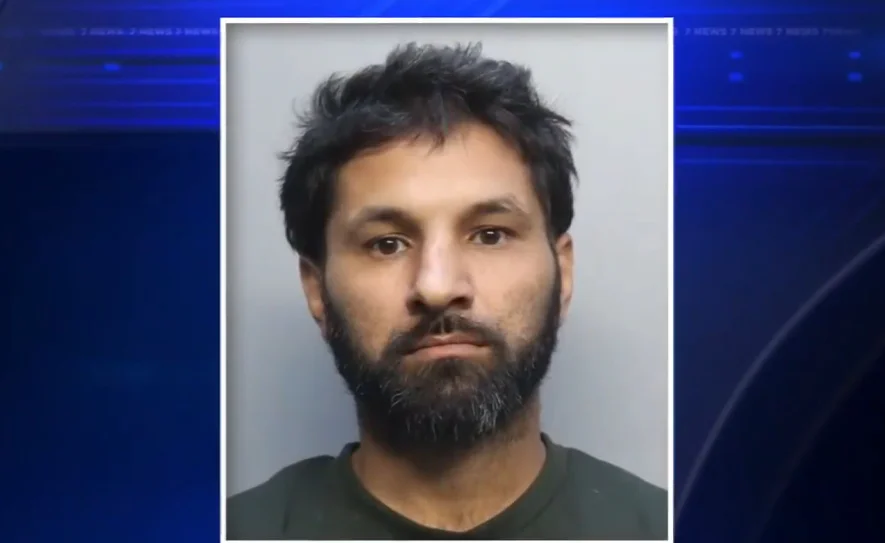

A video of Miami Gardens Police Chief Delma K. Noel-Pratt attending a Ramadan gathering at the Islamic Center of Greater Miami has prompted online criticism over her participation in the event and the institutional affiliations of the mosque.
The footage was circulated alongside commentary alleging that Noel-Pratt wore a hijab while in uniform to enter the mosque for an open-house iftar, the evening meal that breaks the daily fast during Ramadan. The post characterized the visit as a national security concern and called for greater scrutiny of the organizations connected to the religious center.
However, the claims made in the commentary should be distinguished from established facts. The available material does not demonstrate that the police chief’s visit involved unlawful conduct or that the event itself posed a security threat.
What Is Known About the Islamic Center of Greater Miami?
The Islamic Center of Greater Miami operates in Miami Gardens through the Muslim Communities Association of South Florida (MCA), a religious and educational nonprofit established in 1971.
The center’s current website identifies MCA as a member of the Islamic Society of North America (ISNA). An older version of the association’s website also stated that the legal titles to the properties housing the Islamic Center of Greater Miami and the Miami Mosque were held by the North American Islamic Trust (NAIT).
These organizational relationships are central to the online criticism. The commentary argues that public officials should examine the institutional background of organizations they visit, particularly when those institutions have appeared in discussions about Islamist movements and terrorism-related investigations.
The existence of an organizational affiliation, however, does not by itself establish that a religious institution, its current members or a visiting public official has engaged in criminal activity.
The Holy Land Foundation Case and the NAIT Connection
The social media post also points to the federal prosecution of the Holy Land Foundation for Relief and Development, a charitable organization whose leaders were convicted in a case involving financial support for Hamas.
In 2007, federal prosecutors included NAIT among the individuals and entities identified in an attachment to a pretrial filing titled “List of Unindicted Coconspirators and/or Joint Venturers.” The attachment contained 246 names.
The U.S. Court of Appeals for the Fifth Circuit later examined the circumstances surrounding NAIT’s inclusion. Its 2010 opinion explained that the allegation appeared in a government brief in anticipation of a possible evidentiary dispute and had not been tested through a judicial determination concerning NAIT’s alleged participation in the conspiracy.
The court record also states that a lower court had determined that publicly identifying NAIT in the filing violated the organization’s Fifth Amendment rights. The government did not appeal that ruling.
The distinction is significant: the Holy Land Foundation convictions do not mean that every organization mentioned in the government’s pretrial materials was convicted or found criminally liable.
The online commentary also raises historical claims involving former NAIT leaders and their alleged connections to the Muslim Brotherhood. Those claims require separate evidence and should not be treated as proof of wrongdoing by Noel-Pratt or the current leadership of the Islamic Center of Greater Miami.
Florida’s Changing Policy Toward Islamist Organizations
The controversy comes amid broader political and legal disputes over how Florida should respond to organizations that state officials associate with terrorism or extremist movements.
In December 2025, Governor Ron DeSantis issued an executive order designating the Council on American-Islamic Relations (CAIR) and the Muslim Brotherhood as terrorist organizations for purposes of the order.
In April 2026, DeSantis signed House Bill 1471, establishing a statutory framework for state-level terrorist designations. The administration subsequently pursued action under that framework.
The executive order has faced legal challenges. In March 2026, a federal judge preliminarily blocked its enforcement as applied to CAIR, finding that the organization was likely to succeed on its First Amendment claim concerning government pressure on third parties. Separate litigation challenging Florida’s statutory designation framework remained ongoing in October 2026.
These legal disputes concern the government’s authority to designate organizations and the constitutional limits on those actions. They do not establish that the Islamic Center of Greater Miami or its attendees are implicated in terrorism.
Questions About Police Outreach and Religious Neutrality
The video has opened a broader debate about how law enforcement leaders should engage with religious communities while maintaining public confidence in their impartiality.
Police departments regularly interact with residents, religious institutions and community organizations as part of public outreach. Such engagement can provide opportunities to build relationships, improve communication and address community concerns.
Critics of Noel-Pratt’s visit have argued that public officials should carefully examine the organizations with which they associate. Others may view attendance at a religious gathering as a routine form of community engagement.
The more serious allegations raised in the online post require evidence beyond the images of a public official attending a religious event or wearing religious attire.
No evidence presented in the post establishes that Noel-Pratt endorsed Sharia as a governing system, violated her official duties or supported terrorism by attending the gathering.
Separating Documented Facts From Online Allegations
The debate surrounding Noel-Pratt’s visit illustrates how a short video can become the basis for broader claims about religion, public policy and national security.
The center’s stated affiliation with ISNA and the reported property relationship with NAIT are matters that can be examined through organizational records. Historical court documents also provide important context for understanding how those organizations have been discussed in previous federal proceedings.
At the same time, allegations about individual conduct, institutional wrongdoing or national security threats require independent evidence. Historical associations and inclusion in an unindicted-coconspirator list should not be presented as equivalent to a criminal conviction.
The incident ultimately raises questions about transparency, public officials’ community outreach and the importance of evaluating claims about religious institutions through documented evidence rather than social media accusations alone.
Credit: RAIR Foundation USA
Subscribe to the JFN Website and to the JFN WhatsApp Channel